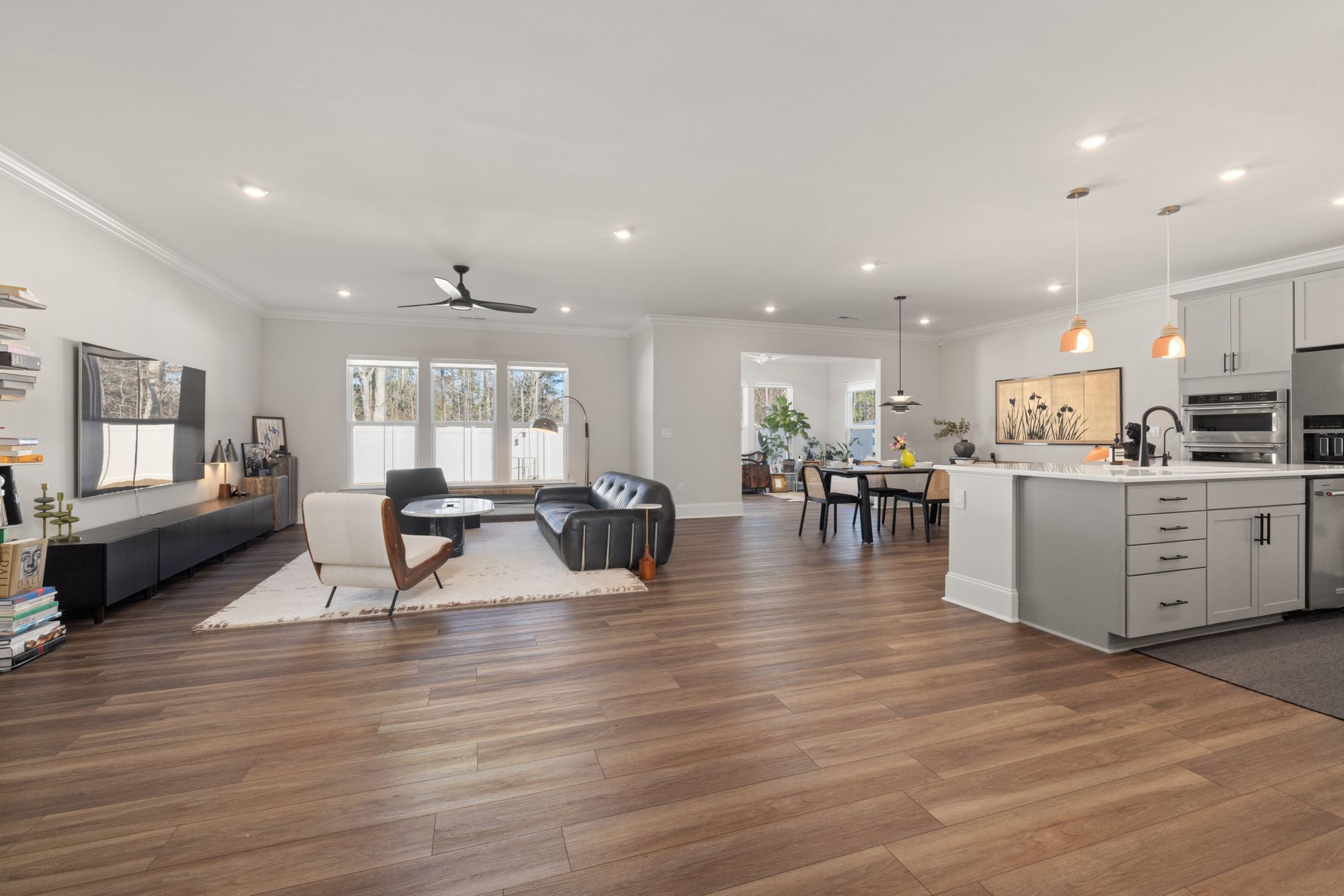
Flooring across Ohio
Nine cities, nine different housing stocks, and nine different answers to the same question. Every figure here is that city's own Census number.
Oldest housing stock first
Median year built and the share of homes predating 1940, by city, alongside the surrounding county. The gap between the two columns on the right is the story in half these places.
| City | Median year built | Built before 1940 | County median |
|---|---|---|---|
| Cleveland | 1941 | 48.6% | Cuyahoga County — 1957 |
| Canton | 1947 | 41.5% | Stark County — 1966 |
| Youngstown | 1950 | 39.3% | Mahoning County — 1963 |
| Cincinnati | 1951 | 40.9% | Hamilton County — 1963 |
| Dayton | 1951 | 36.7% | Montgomery County — 1966 |
| Akron | 1954 | 34.1% | Summit County — 1966 |
| Toledo | 1955 | 31.0% | Lucas County — 1963 |
| Parma | 1958 | 10.4% | Cuyahoga County — 1957 |
| Columbus | 1980 | 12.0% | Franklin County — 1979 |
Housing figures for this page: U.S. Census Bureau, American Community Survey 2020–2024 5-year estimates, tables B25034 and B25035.
Pick your city
Each page covers that city's housing stock, what it does to a floor, and installed cost ranges adjusted for regional labor.
Why the city matters more than you would think
Columbus city’s median house was built in 1980. Cleveland’s was built in 1941. Those are the same state and a thirty-nine-year gap, and they are not the same job.
Parma splits the other way from the city it borders: 10.4% of its housing predates 1940 against 48.6% in Cleveland itself. A county average would hide both.
Questions people actually ask
Does my flooring contractor have to be registered in Ohio?
As of 1 January 2026, yes, for residential work on one- to three-family homes. HB 614 created Ohio's first statewide Home Improvement Contractor registration through the Ohio Construction Industry Licensing Board; before that there was no state license for flooring at all. Registration requires a criminal background check, a $25,000 surety bond, $500,000 in general liability and workers' compensation. Your city may require its own registration on top of the state one.
What flooring actually works in an Ohio basement?
Luxury vinyl plank, in most cases. It is waterproof, it floats directly over a concrete slab, and it handles the temperature and humidity swing below grade. Carpet works in a dry, finished basement with a good vapor barrier. Solid hardwood does not belong below grade.
Is it worth refinishing instead of replacing?
When there is enough wood left to sand, refinishing typically runs about a third of the cost of new hardwood. Solid strip flooring can usually take several sandings across its life; engineered wood depends entirely on how thick its top veneer is. In cities like Cleveland and Canton, where roughly two in five homes predate 1940, there is a real chance the best floor in the house is already in the house.
Why is flooring cheaper in Youngstown than in Columbus?
Material is a national commodity and costs about the same everywhere. Labour is not, and it is the only part of an installed price that genuinely varies across Ohio. Columbus and the Cleveland suburbs sit at the top of each band; Youngstown, Canton and rural counties sit at the bottom.