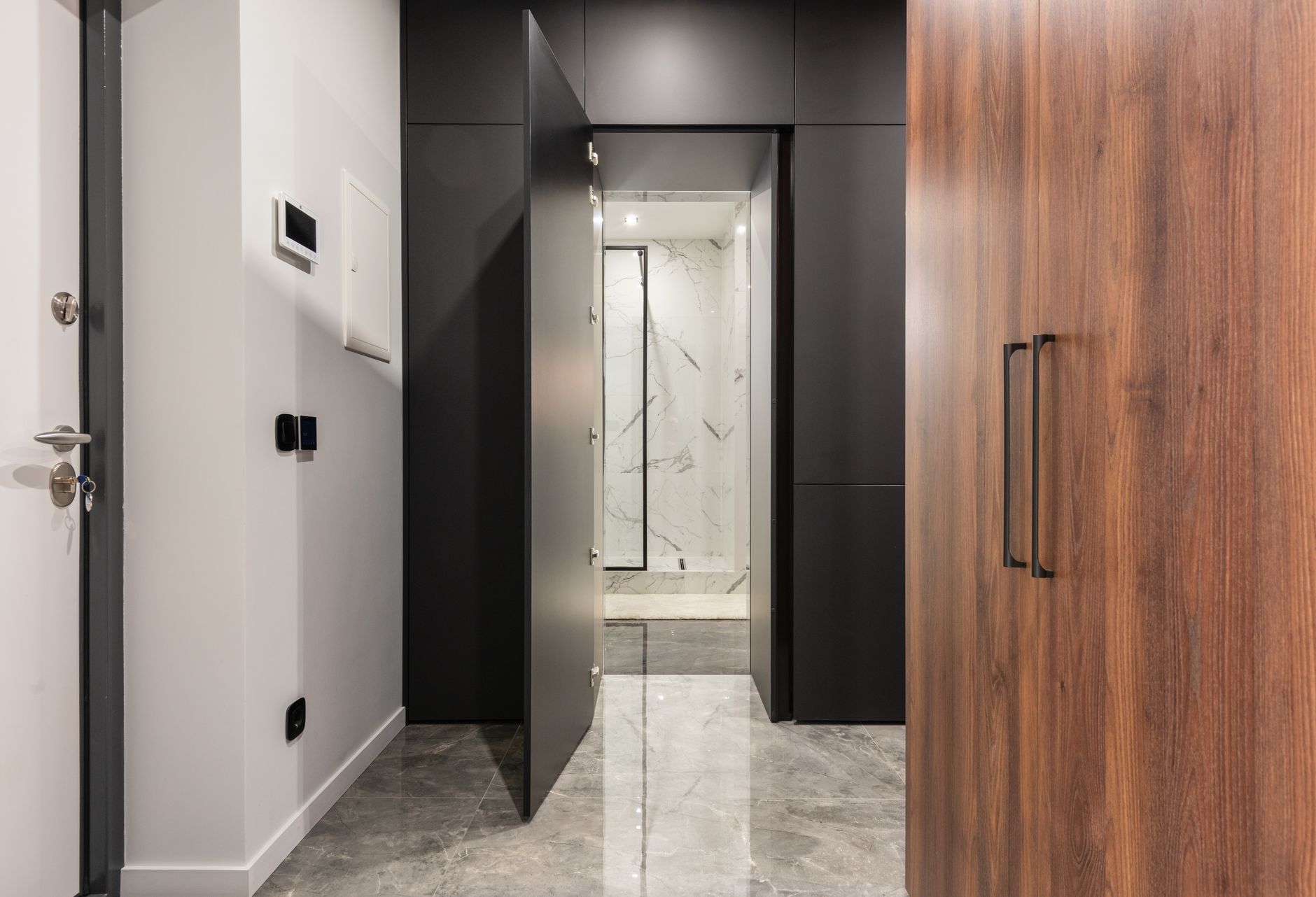
Natural Stone and Marble Flooring in Ohio: Where It Belongs
Stone is the one floor that is unambiguously doing the talking in a room. It is also the one with the most ways to go wrong, and most of them are about picking the right stone for the right room rather than about installation.
The stones behave completely differently
“Natural stone” covers materials with almost nothing in common except that they came out of the
ground:
- Marble — beautiful, soft, and calcium carbonate, which means acid etches it.
Lemon juice, wine and many cleaning products leave a dull mark that is not a stain and does not wipe
off. Marble belongs in a foyer or a powder room, not under a kitchen sink. - Granite — hard, dense, acid-resistant. It is the practical one, and it is
heavy. - Slate — naturally textured, so it is genuinely good underfoot when wet, which
makes it a real candidate for an Ohio entryway. Some slates spall in layers over time. - Travertine and limestone — porous and soft. They want sealing and they want to
stay away from road salt.
Freeze, salt and the Ohio entryway
If stone is going anywhere that sees winter — a front hall, an enclosed porch, a mudroom — the
question is absorption. A porous stone that takes on water and then freezes will spall, and de-icing
salt attacks the softer carbonate stones directly. Granite and a dense slate handle it. Polished
marble and travertine, in that location, do not.
What stone costs in Ohio
Installed, natural stone runs roughly $15 to $40 a square foot in Ohio,
and the range is that wide because the material itself ranges from ordinary to extraordinary. Labor
is high across all of it: stone is heavy, it is cut wet, and setting it flat is slow work.
An estimate, not a quote. These are planning ranges for Ohio, not a quote. What you actually pay depends on your rooms, your subfloor and the material you choose.
The recurring cost people are not told about is sealing. Most natural stone needs re-sealing
periodically, and the interval depends on the stone and the traffic. It is a small job; it is not a
zero job, and it is the difference between a floor that looks like this in ten years and one that
does not.
The weight question in an older house
Stone is substantially heavier than tile, and tile is already heavier than what most old
Ohio floor framing was designed to carry. In a house with century-old joists this is a real
structural conversation, not a formality — particularly on a second floor. It is worth having before
the stone is ordered.
Frequently asked questions
Is marble too slippery for a hallway?
Polished marble is slippery when wet, which is the main argument against it at an entry in a
climate with five months of tracked-in snow. Honed marble has considerably more grip and is the
usual compromise.
Can natural stone go over radiant heat?
Yes, and stone is very good at it — it holds heat well. The installation needs the correct
uncoupling and the heating system needs to come up to temperature slowly the first time.
How often does stone need sealing?
It depends on the stone and the traffic; a dense granite may go years, a porous limestone in an
entryway may want it annually. The simple test is to leave a few drops of water on the surface — if
it darkens the stone within a few minutes, the seal is gone.