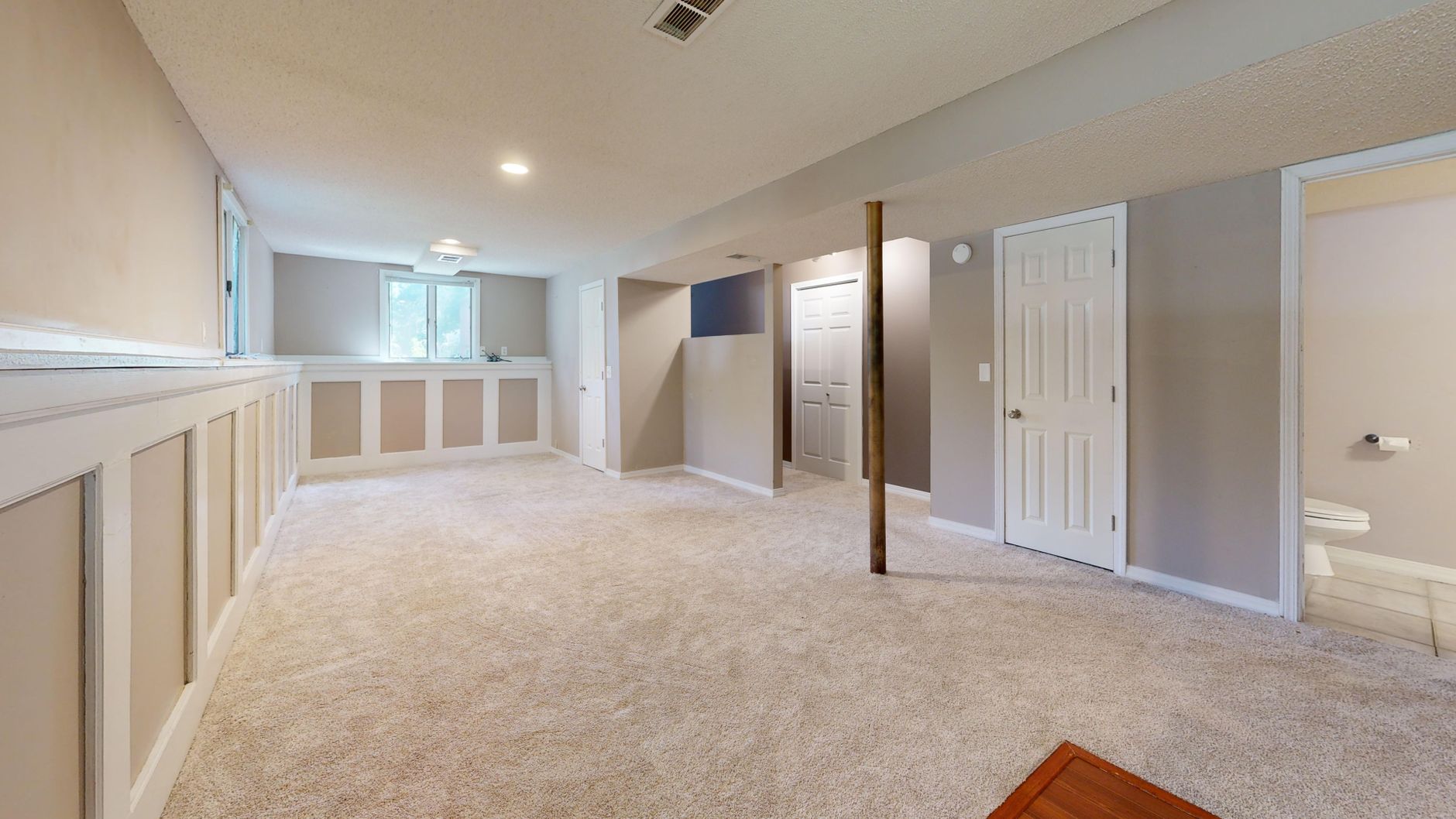
Basement Flooring in Ohio: What Works Below Grade and What Fails
Ohio is a basement state, and a basement is not just a colder room. It is a concrete slab in contact with wet ground, and that single fact rules out several materials that are perfectly good one floor up.
The problem is vapour, not water
Most basement flooring failures are not caused by a flood. They are caused by moisture moving
steadily up through the slab as vapour, which it does whether or not you have ever seen standing
water. Concrete is porous. The ground under it is damp. Over months, that moisture arrives at the
underside of whatever you laid on top.
The cheap test is not a bad one: tape a two-foot square of clear plastic sheeting tightly to the
slab, leave it for a couple of days, and look at the underside. Condensation means the slab is
passing moisture, and that changes what you can install.
What works
- Luxury vinyl plank. Waterproof, dimensionally stable across the temperature
swing, and it floats directly over concrete without needing a plywood overlay. This is why it has
taken over Ohio basements, and it is usually the right answer. - Tile and porcelain. Entirely unbothered by moisture, and the most durable
option down there. It is cold and hard underfoot, and the slab needs to be flat and crack-free
first. - Carpet, conditionally. Fine in a dry, finished basement with a real vapour
barrier and a pad rated for below grade. A disaster the one time it gets wet. - Engineered wood, cautiously. Handles below-grade conditions far better than
solid, but it is still an organic material sitting over a moisture source.
What does not
Solid hardwood does not belong below grade. It expands and contracts with
moisture, and a slab supplies moisture indefinitely. It is a mistake that takes about two years to
become visible — cupping first, then gaps, then boards lifting at the seams. Laminate is the other
common regret: the core is compressed fibreboard, and fibreboard and moisture do not co-exist.
Level the slab first
Basement slabs are frequently not flat, especially around a floor drain, where they were
deliberately sloped. Floating floors need a flat plane — most manufacturers specify something close
to 3/16″ over 10 feet — and a floor laid over a dished slab will flex, click and eventually break at
the joints. Self-levelling compound is the usual fix and is a real line item, not an upsell.
Common questions
Do I need a vapour barrier under luxury vinyl plank?
Many products include an attached pad or built-in barrier. If yours does not, use one — over
concrete it is not optional.
My basement has never been wet. Does this still apply?
Yes. “Never flooded” and “does not pass vapour” are different claims, and the plastic-sheet test
tells you which one you have.
What about a basement that floods occasionally?
Then the requirement is a floor that can get wet, be dried, and continue to exist — tile, or
luxury vinyl plank laid so it can be lifted. Nothing organic and nothing glued down permanently.