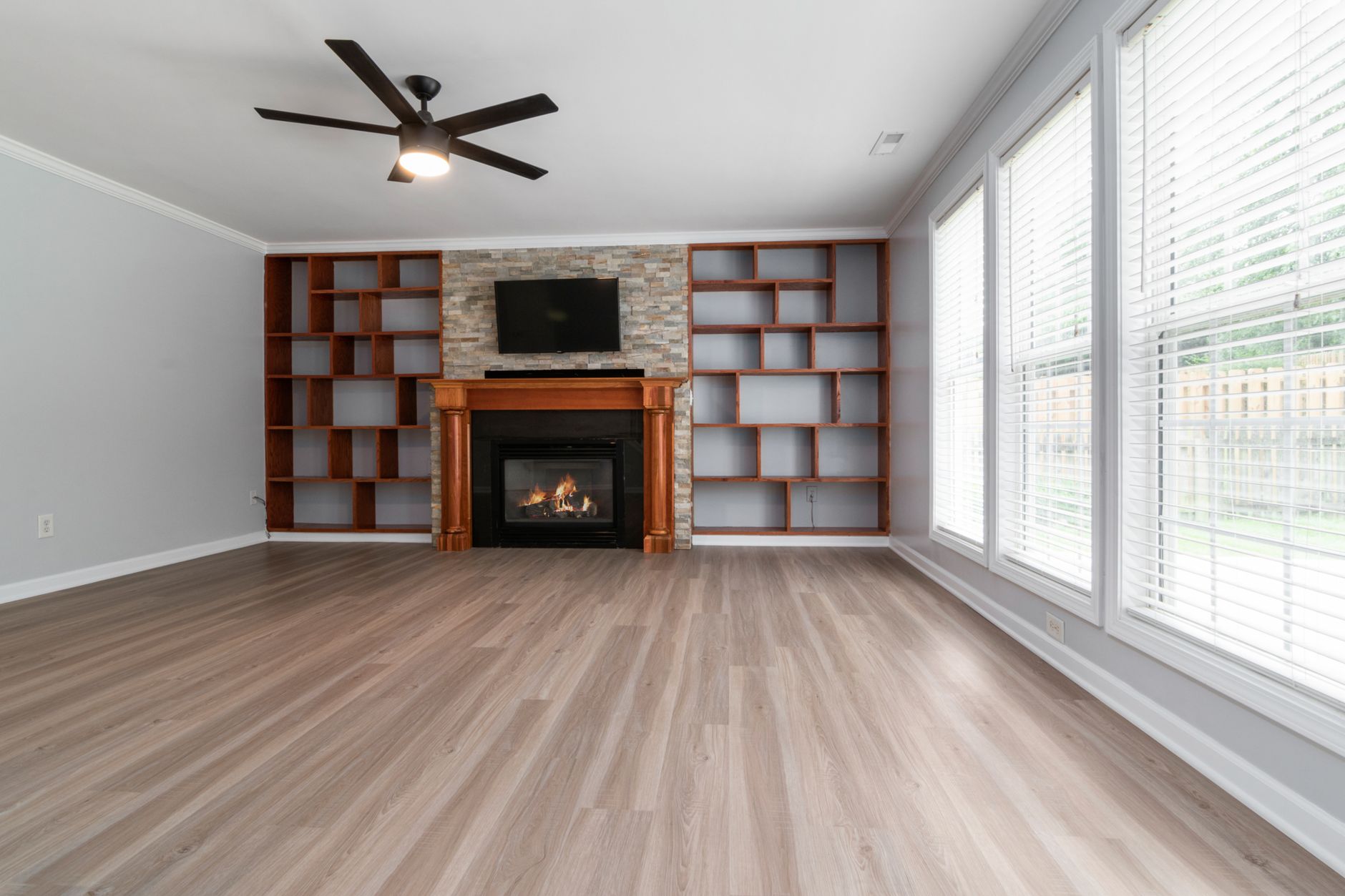
Luxury vinyl plank installed runs $2 to $12 a square foot whether the job is in Columbus or Cleveland — the material and its price range don’t change city to city. What does change is how much labor the crew has to do before the first plank ever clicks into place, and that’s driven by the age of the house underneath it, not the ZIP code.
Columbus has a median home built in 1980, with about 12% of its housing predating 1940. Cleveland’s median home was built in 1941, and nearly half its housing stock — 48.6% — predates 1940 (U.S. Census Bureau, American Community Survey 2020-2024 5-year estimates). That gap is the whole story. A newer subfloor is flat and predictable. An older one usually isn’t, and LVP is unforgiving about flatness in a way carpet never was.
Why does the same flooring cost more to install in Cleveland?
It isn’t that Cleveland labor rates are dramatically higher. It’s that a much larger share of Cleveland’s houses need subfloor prep — leveling compound, luan underlayment, or fastening down loose boards — before LVP can go down at all. That prep work is labor, and it’s what pushes a job toward the top of the $2-$12/sq ft range instead of the bottom.
Columbus, with a younger overall housing stock, more often lets a crew move straight from removal to installation. Fewer surprises under the old floor means fewer hours billed, and the finished job tends to land closer to the lower and middle part of the range.
What’s actually different about the subfloors?
LVP is a rigid-feeling floating or glue-down product, and it telegraphs whatever is beneath it. Dips, humps, and squeaks that carpet padding used to hide will show up as visible seams or hollow spots once vinyl plank is down.
- Diagonal 1×6 plank subfloors. Common in homes built before the 1940s, these were standard practice long before plywood took over. They flex differently than plywood and often need an underlayment layer before LVP can be installed over them.
- Settled joists. Older joists that have deflected more than current code allows can create a slight bounce that’s tolerable under carpet but reads as a spring underfoot with rigid-core LVP.
- Multiple old flooring layers. Homes with a century of renovations sometimes carry three or four flooring generations stacked on top of the original subfloor, and each one has to be evaluated, not just covered over.
None of this makes an older house a bad candidate for LVP. It means the estimate has to account for prep, and a Cleveland bid that looks higher than a Columbus one for a similar square footage is very often paying for that difference rather than for pricier materials.
How much of the LVP price is material versus labor?
On a straightforward job — flat subfloor, no removal needed, standard room shape — material is often the bigger line item within that $2-$12/sq ft range, since LVP itself spans budget sheet vinyl look-alikes up through waterproof rigid-core products with realistic embossing.
Once removal, leveling, or underlayment enters the picture, labor’s share grows quickly. Removing an old floor is its own line item, typically $1 to $4 a square foot depending on what’s coming out and how many layers are stacked underneath. A house with three old flooring generations to strip out before LVP goes in will spend meaningfully more on removal than a house with a single layer of dated vinyl.
These are planning ranges, not quotes — the final number for any specific room depends on square footage, subfloor condition, and the grade of plank chosen. The flooring cost estimator walks through those variables for a reader’s own project rather than guessing from a citywide average.
Does an older house mean asbestos is a factor?
It can be, and it’s worth taking seriously before any old flooring comes up. Vinyl flooring and adhesives installed before the early 1980s sometimes contain asbestos, and that risk rises with the age of the material, not the age of the house alone — Cleveland’s older housing stock simply has more of these older layers still in place.
This is not a call any homeowner or contractor can make by eye. A certified testing laboratory is the actual authority here, and testing before removal is the reasonable next step in any pre-1980s home where the existing flooring hasn’t already been identified. The EPA publishes general guidance on asbestos in the home for readers who want the background before that test.
Does LVP need a permit in Columbus or Cleveland?
Flooring replacement alone typically doesn’t trigger a permit, but that answer is never a statewide one. Permits in Ohio are enforced locally under the Uniform Construction Code, so the only reliable source is the reader’s own municipal building department — not a general rule published anywhere else, including this site.
If the project also involves subfloor replacement, moving a threshold, or work that touches a load-bearing element, that’s exactly the kind of detail a local building department needs to weigh in on before work starts.
Where does LVP not belong?
LVP earns its popularity — it’s a genuinely useful floor for a lot of Ohio houses — but it isn’t the right choice everywhere. It’s a poor match for rooms where a homeowner wants the specific look and resale weight of real wood, since even the best LVP is a photographic layer over a core, not solid material. It’s also not the product to reach for in a formal room where hardwood’s ability to be sanded and refinished over decades matters more than upfront cost. Below-grade spaces carry their own separate set of rules around moisture and vapor, covered in more detail on basement flooring in Ohio — LVP can work there, but the subfloor and moisture testing requirements are different from a main-floor installation.
Who does the hiring and verification homework?
Whoever hires the installer is the one who needs to check credentials, not assume a bid implies them. Ohio’s HB 614 contractor registration changes are worth understanding before signing anything, and the Ohio Office of Attorney General maintains a public register for exactly this kind of verification.
A written estimate that separates removal, prep, and installation into distinct line items is a reasonable thing to ask for regardless of city — it’s the only way to see where the labor difference between an older and newer house is actually landing in the number.
Frequently asked questions
Is LVP cheaper in Columbus than in Cleveland?
The published range is the same, $2-$12/sq ft installed, in both cities. Columbus jobs more often land toward the lower half of that range because the housing stock is newer on average and needs less subfloor prep; Cleveland jobs more often need leveling or underlayment work first, which pushes the total higher within the same range.
What makes an LVP estimate go up the most?
Subfloor prep and old-floor removal are usually the biggest swing factors, more than the plank product itself. A flat, single-layer subfloor keeps a job near the bottom of the range; multiple old flooring layers or an uneven diagonal-plank subfloor push it toward the top.
Can LVP go over an old diagonal-plank subfloor?
Often yes, but usually with an underlayment layer added first to manage the flex and gaps common in that older construction. Whether it’s needed depends on the specific subfloor’s condition, which is a site evaluation, not a general rule.
Does replacing LVP require a permit?
Straight flooring replacement usually doesn’t, but permitting is enforced by each Ohio municipality individually. The reader’s own local building department is the only reliable source for their specific project.
For a broader look at how material choice and city housing stock interact across Ohio, the installed flooring cost hub and the city-by-city housing stock page cover the other seven materials and the other seven cities this article didn’t. The flooring materials hub and the room-by-room archive are useful next stops for matching a specific material to a specific space, and the hiring and permits archive covers the verification steps referenced above in more depth.
OH Floors is an independent Ohio flooring resource. We do not sell or install flooring, we do not quote jobs, and nobody from this site will call you. Cost figures here are published planning ranges for Ohio, not quotes — what you actually pay depends on your rooms, your subfloor and the material you choose, and the final price depends on your project. Photography is licensed stock used to illustrate materials and rooms; it is not work by anyone connected to this site. Building code and permit requirements are enforced locally in Ohio, so confirm anything regulatory with your own municipality before you rely on it.
Any prices mentioned are indicative only. Tool prices move constantly and vary by market, by retailer, and by whether a kit includes batteries or a charger — check the current price yourself before deciding.
Featured image: Photo by Curtis Adams via Pexels.