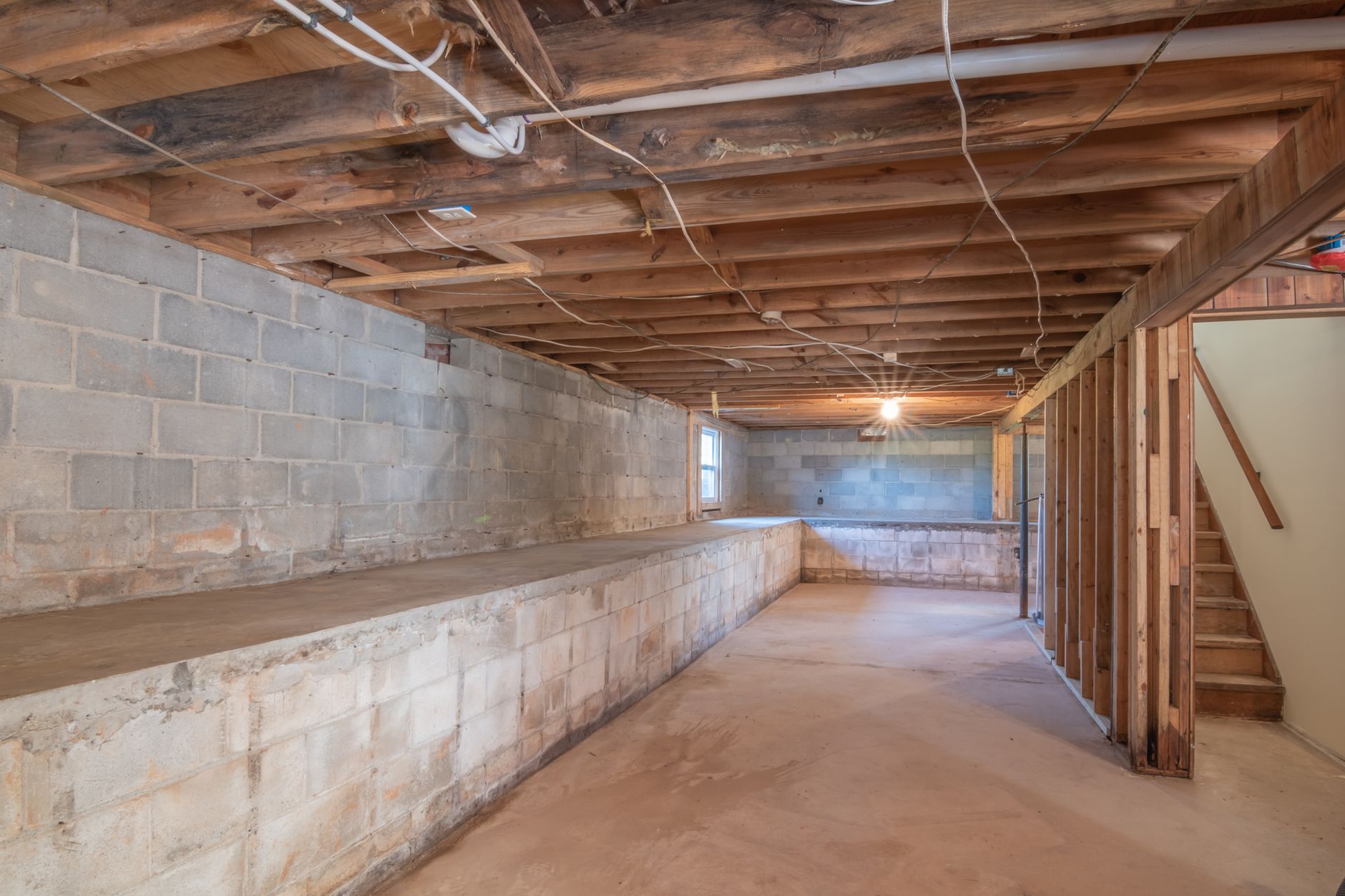
Below grade, the short list is rigid-core luxury vinyl plank, ceramic or porcelain tile, and sealed or coated concrete left bare. Solid hardwood does not belong down there under any circumstances, laminate is a gamble even in a dry basement, and carpet only works with the right subfloor system underneath it. The deciding factor is moisture, not style.
What flooring actually survives in an Ohio basement?
Waterproof rigid-core luxury vinyl plank and ceramic or porcelain tile are the two materials that consistently hold up below grade in Ohio. Both are dimensionally stable when the concrete underneath sweats, both tolerate an occasional damp spell without swelling, and both can go directly over a slab with the right prep. Everything else on this site’s material list carries some kind of below-grade compromise.
That is not a knock on the other materials — it is what concrete does. A basement slab sits in contact with soil and, in much of Ohio, with a water table that rises and falls with the season. Even a slab that looks bone-dry is releasing vapor upward, and that vapor is what ends the life of the wrong flooring choice.
Why do basements fail floors that work everywhere else?
Three things separate a basement from the rest of the house: the subfloor is concrete rather than plywood, the concrete is in direct contact with the ground, and the space usually has the least ventilation in the house. Any material sensitive to moisture or made from wood cells reacts to that combination before it reacts to foot traffic.
Ohio’s clay-heavy soils compound the problem. Clay drains slowly, so water sits against foundation walls longer after a storm than it would in sandier soil. Older foundations — the stone and rubble-wall basements common under homes built before 1940 — were rarely built with a modern footing drain or a below-slab vapor barrier at all. A slab poured against that kind of wall, or poured with no vapor barrier underneath it, is not a defect to panic over, but it is a different starting point than a 1990s poured-concrete foundation with drain tile.
What is the safest below-grade flooring choice?
Rigid-core luxury vinyl plank is the most forgiving option for a finished Ohio basement. It is fully waterproof through the plank itself, it floats or glues directly to a prepared slab, and it handles the temperature swings of an unconditioned space better than any wood-look product on the market.
Luxury vinyl plank installed runs roughly $2 to $12 per square foot, with the range driven mainly by plank thickness, wear layer, and whether the slab needs leveling or moisture mitigation first. These are planning figures, not a quote — the actual number depends on the condition of the specific slab and the plank chosen, and the flooring cost estimator is the better tool for a project-specific range. The materials hub at flooring materials covers where LVP performs well and where it does not.
Where does tile make sense below grade?
Ceramic and porcelain tile survive basement moisture indefinitely because the material itself does not absorb water the way wood or vinyl backing can. It is a strong choice under a basement bathroom, a laundry area, or any room near a floor drain or sump pit.
Tile runs about $9 to $14 per square foot installed, and natural stone — if a reader wants that look in a basement, which is unusual but not unheard of — runs $15 to $40. Both figures are estimate ranges only; grout choice, tile size, and how much the slab needs to be flattened before setting tile all move the final number. Tile’s real below-grade weakness is comfort, not durability: it is cold underfoot in an unconditioned basement and unforgiving if anyone falls on it, which is worth weighing against how the room will actually be used.
What about carpet in a basement?
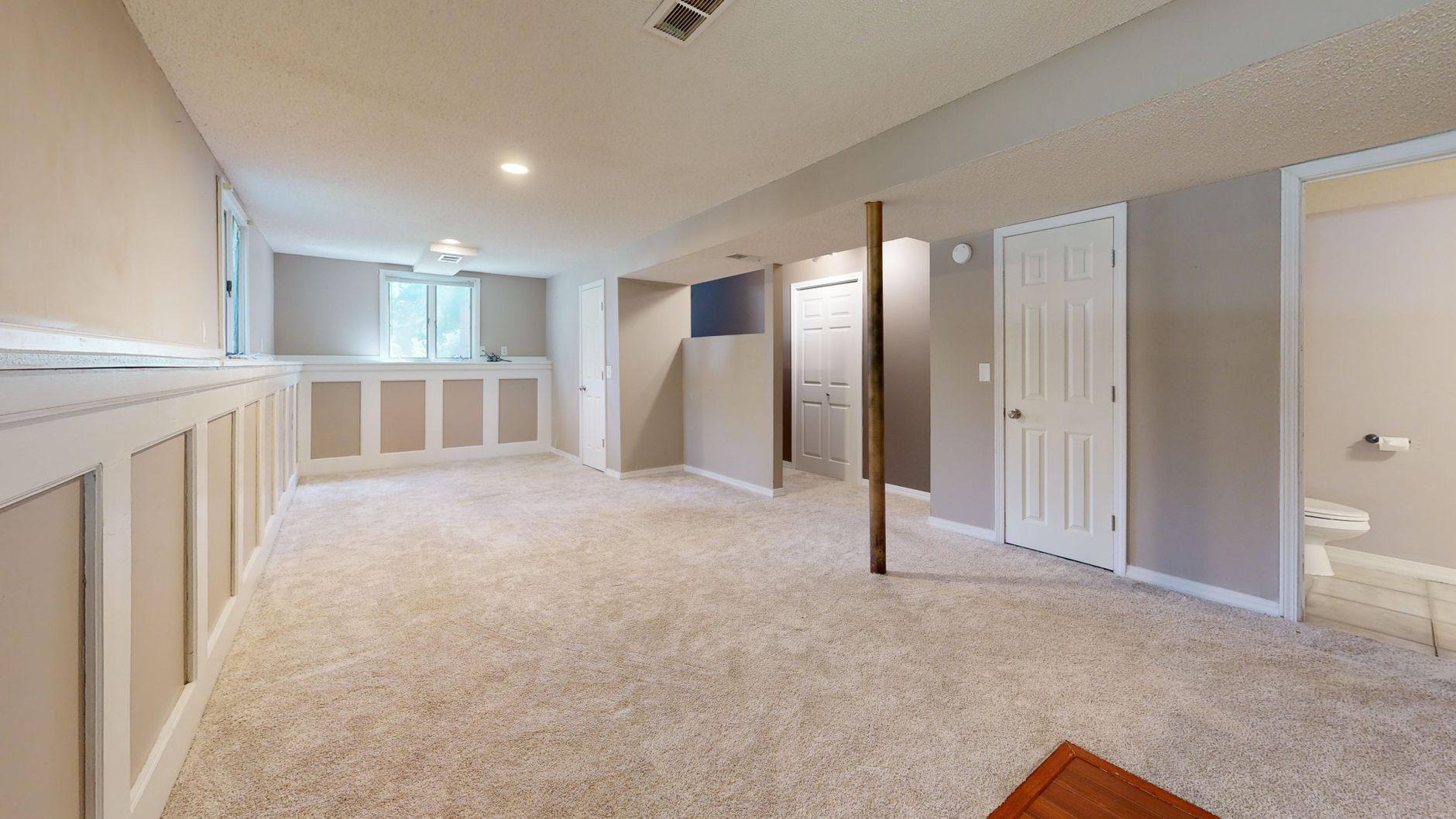
Carpet can work in a finished basement, but only as part of a system, not as carpet laid directly on concrete. That means a basement-rated pad or a raised subfloor panel underneath, both designed to keep the carpet fibers off the slab and let any vapor escape sideways instead of soaking upward.
Installed carpet runs $2 to $8 per square foot as a planning range, before adding whatever subfloor system the basement needs — again, a project-specific figure the Ohio flooring cost hub and the estimator handle better than a single number can. Carpet laid straight onto bare concrete in a basement is the fastest way to grow mold under it, and that failure often shows up as a smell before it shows up as visible damage.
Why don’t solid hardwood and laminate belong below grade?
Solid hardwood is a wood product that expands and contracts with humidity, and a basement slab is the most humid subfloor in the house. Even engineered wood, which is built to resist that movement better than solid strip flooring, is not a safe default below grade — manufacturers vary widely in how they rate their own products for basement use, and a warranty claim denied for below-grade installation is a common and avoidable outcome.
Laminate is the trickier case, because it looks like a reasonable compromise and often is not one. Its core is compressed wood fiber, and once that core takes on water it swells permanently — it does not dry back out and return to its original shape the way concrete does. Laminate installed runs $3 to $10 per square foot as a planning figure, but that range assumes a normal subfloor, and a basement is not a normal subfloor. A reader set on laminate below grade should treat that decision as higher risk than the same product upstairs, and confirm with the manufacturer’s own basement rating before buying, not after.
What does older Ohio housing change about a basement project?
A large share of Ohio’s basements sit under houses built well before modern building codes existed. The U.S. Census Bureau’s American Community Survey puts the state’s median home year built at 1965, with a quarter of the housing stock built before 1940 — figures that hold differently city to city, as the city-by-city flooring guide lays out for Cleveland, Cincinnati, and the rest.
Two things come up disproportionately often in these older basements. The first is an existing 9-inch-by-9-inch vinyl composition tile floor, common through the mid-20th century, which can contain asbestos. The general position from public health authorities is that intact material in good condition is lower risk than material that is cut, sanded, or pried up — but confirming what a specific floor contains is a job for an accredited testing laboratory, not a guess from an online description. The second is older sump and drainage systems that were adequate when installed but were never upgraded alongside a later basement finish; that is worth a plain look before flooring goes down, not after.
Finishing a basement also typically triggers a permit review under Ohio’s Uniform Construction Code, which is enforced at the municipal level rather than the state level. What that means for a specific project — egress requirements, ceiling height, electrical work tied to the flooring job — is a question for the reader’s own city or county building department, not a statewide rule this article can state on their behalf.
What does a basement floor cost overall?
Removing whatever is down there now — old carpet, failed vinyl tile, a previous laminate attempt — runs about $1 to $4 per square foot, and that step often reveals the condition of the slab underneath before any new material goes in. From there, the material choices above cover most of the total, and the flooring cost estimator is built to combine removal, prep, and material into a single planning range for a specific basement rather than a generic one. Every figure in this article is a starting range, not a quote — the final price for any basement depends on its own slab condition, moisture history, and square footage.
Frequently asked questions
Can hardwood ever go in an Ohio basement?
Not solid hardwood. Some engineered wood products are rated by their manufacturer for below-grade use, but that rating varies by brand and should be confirmed directly with the manufacturer before buying, not assumed.
Is vinyl plank actually waterproof below grade?
The plank itself is waterproof through its core. What still matters is the slab underneath — standing water or a failed sump system can undermine the installation even if the plank material itself survives contact with moisture.
Does an old basement floor need asbestos testing before removal?
That depends on the material and its condition, and it is a question for an accredited testing laboratory rather than a visual guess. Older vinyl composition tile in particular is worth confirming before it is cut, sanded, or pried up.
Does finishing a basement floor require a permit in Ohio?
Permitting for basement work is handled locally under Ohio’s Uniform Construction Code. The requirements for a specific address are a question for that municipality’s building department, not a statewide answer.
OH Floors is an independent Ohio flooring resource. We do not sell or install flooring, we do not quote jobs, and nobody from this site will call you. Cost figures here are published planning ranges for Ohio, not quotes — what you actually pay depends on your rooms, your subfloor and the material you choose, and the final price depends on your project. Photography is licensed stock used to illustrate materials and rooms; it is not work by anyone connected to this site. Building code and permit requirements are enforced locally in Ohio, so confirm anything regulatory with your own municipality before you rely on it.
Any prices mentioned are indicative only. Tool prices move constantly and vary by market, by retailer, and by whether a kit includes batteries or a charger — check the current price yourself before deciding.
Featured image: Photo by Curtis Adams via Pexels.